Overview & Pedagogical Objective
Conversational fluency is fundamentally interactive. Traditional solo shadowing trains articulatory stamina, but real-world workplace discussions require dynamic responsiveness: hearing a partner’s cue, interpreting their intonation contour, formulating a timely response, and speaking with clear prosody and confidence.
Role-Play Shadowing bridges the gap between solo drill and live conversational sparring. By assigning yourself a distinct persona (e.g. Engineer) and treating the dialogue partner (e.g. Tech Lead) as a live acoustic trigger, you train conversational anticipation, natural turn transitions, and acoustic phonology fidelity.
flowchart TD
  subgraph Stage1 ["1. Role Selection & Persona Priming"]
    R1["Select Target Role\n(Engineer / Tech Lead via Role Filter)"]
  end

  subgraph Stage2 ["2. Partner Cue Triggers"]
    P1["Audition Partner Lead-In\n(Listen to Boundary Pitch & Turn-Taking Gap)"]
  end

  subgraph Stage3 ["3. Echoic Rehearsal"]
    E1["Automated Echoic Pause\n(Hold Acoustic Trace & Record Spoken Take)"]
  end

  subgraph Stage4 ["4. Disparity Audit"]
    A1["A/B Comparative Audition\n(Waveform Alignment, Flap-T, Pitch Contour)"]
  end

  Stage1 --> Stage2
  Stage2 --> Stage3
  Stage3 --> Stage4
The Role-Play Rehearsal Cycle (4 Core Phases)
Follow this deliberate 4-step protocol to master conversational turn-taking:
Role Selection & Conversational Persona Priming
Identify your target persona (Engineer) versus the conversational partner (Tech Lead). Focus on the partner's conversational pacing and lead-in cues before preparing your response.
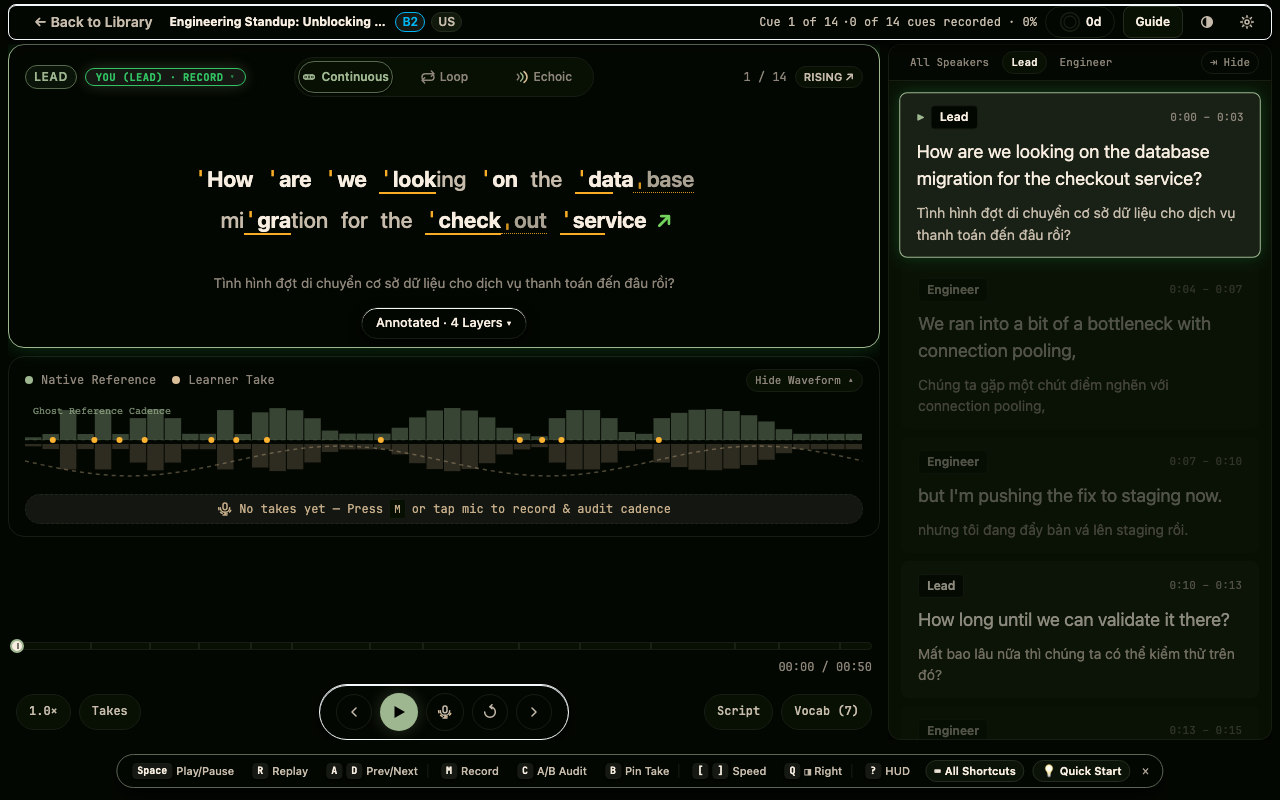
Select the Engineer role filter from the role selector header. Notice how the partner's dialogue turns remain visible as listening cues while your assigned dialogue turns are highlighted for active shadowing.
When launching the scenario, the Studio surfaces dedicated role filter buttons for Lead and Engineer. Selecting your role establishes persona boundaries: partner lines provide the communicative stimulus, while your assigned cues become active recording targets.
Pre-reading the partner's dialogue cues helps predict conversational velocity and pitch transitions. Treat the partner's concluding intonation as your launchpad.
Muting or ignoring the partner's lines entirely. Natural speech is reactive — listening attentively to partner cues builds conversational timing and authentic turn transitions.
Partner Cue Listening & Conversational Trigger Absorption
Listen to the Tech Lead ask about the database migration. Note the boundary pitch contour signaling that the conversational floor is being handed to you.
Press Space to listen to Cue 1. Observe the pitch contour and vowel reductions in the partner's cue without vocalizing.
The partner’s cue serves as your acoustic trigger. Rather than reading transcript text, absorb the lead-in melody into your working memory. The pitch inflection at the end of the partner’s line signals whether a direct response or clarification is expected.
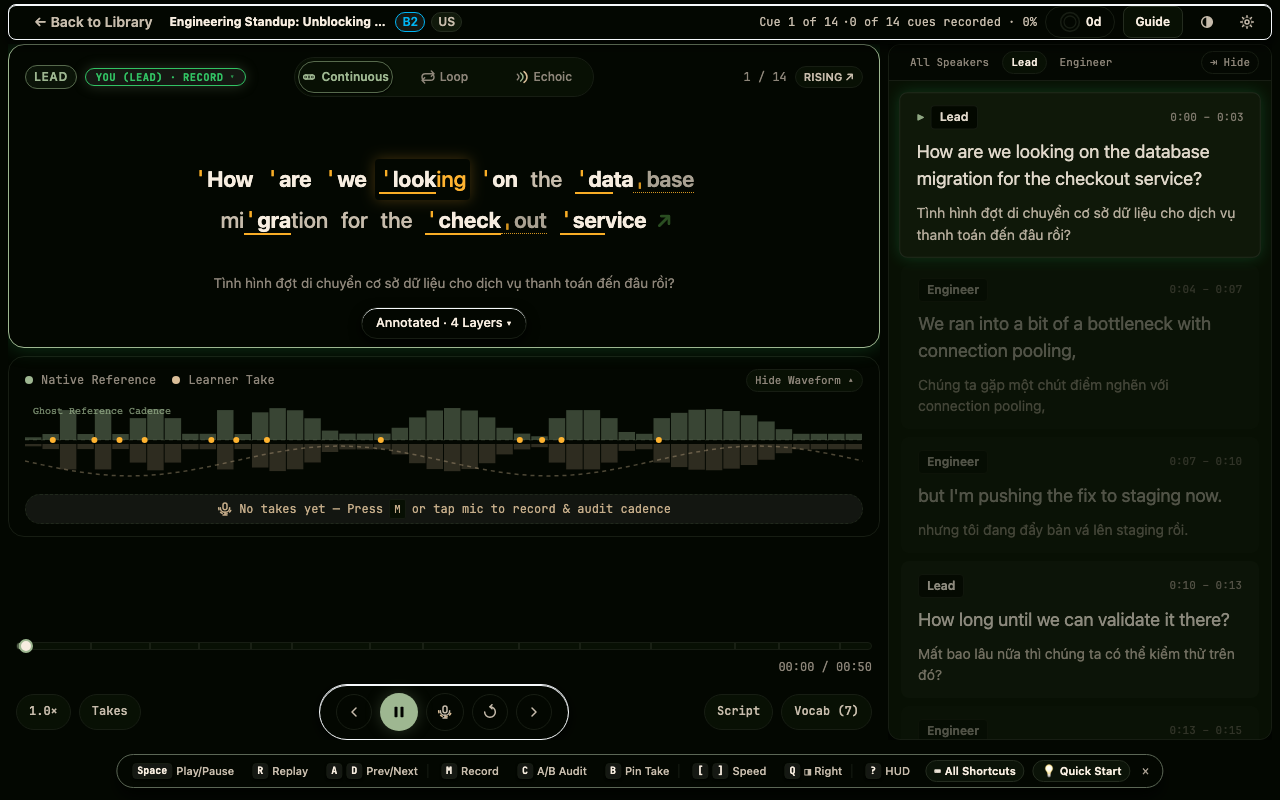
In authentic standups, questions frequently conclude with a terminal fall or slight plateau. Listen for the partner's final vowel decay to time your vocal entrance with zero hesitation.
Rushing to speak before the partner finishes speaking. Jumping in prematurely disrupts speech cadence and ruins the natural 200ms conversational pause.
Echoic Rehearsal & Active Turn-Taking Execution
Hold the partner's prompt in your echoic loop, then replicate the Engineer's assertive blocker explanation ('We ran into a bottleneck with connection pooling...'). Focus on flap-t in 'bottleneck' and strong stress on key nouns.
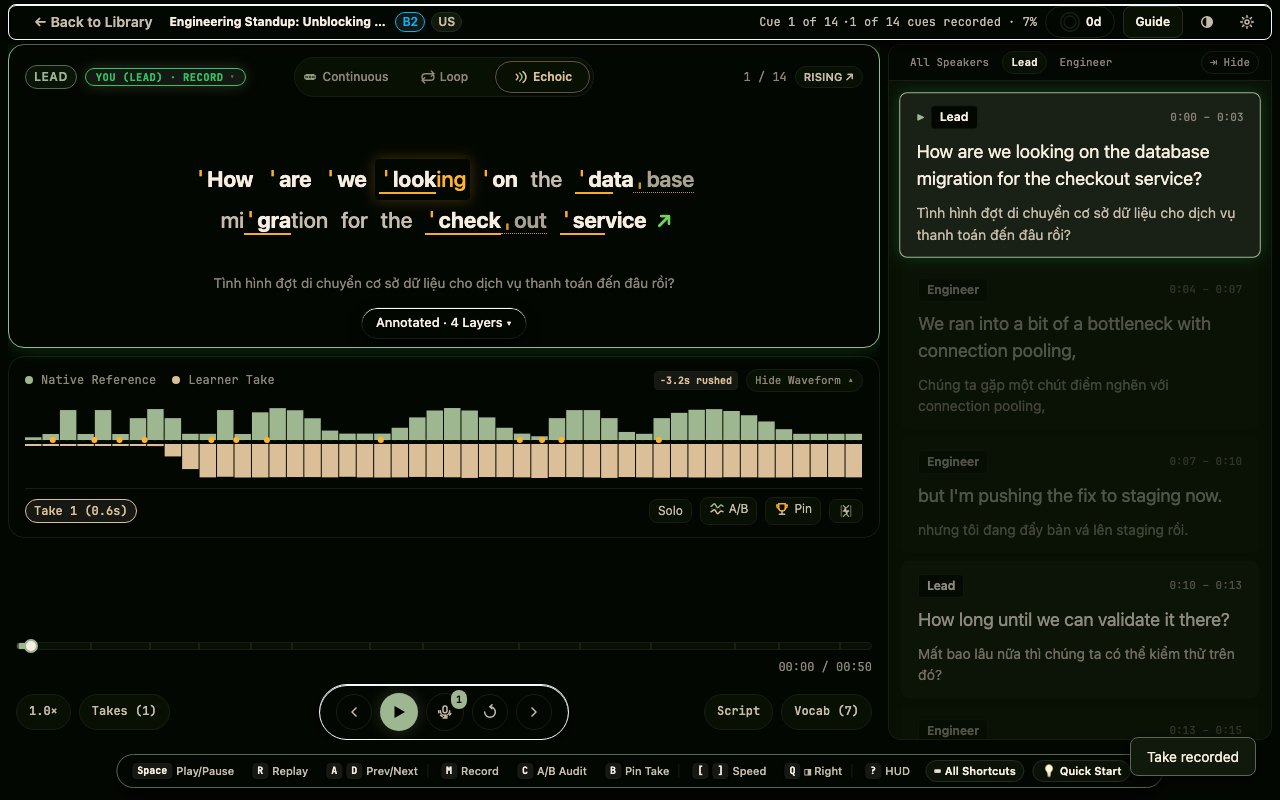
Switch to Echoic Mode. Let the automated echoic countdown trigger microphone capture, vocalize the response at conversational volume, and press R to finalize your take.
In Echoic Mode, the player isolates the active dialogue cue and initiates a calibrated turn-taking pause (duration × 1.6 + 1.2s). The pre-armed microphone captures your vocalization without mouse clicks, preserving your neuromuscular speech rhythm.
Anchor your breath on the partner's final syllable. Inhaling during the partner's cue decay prepares your vocal tract for immediate, resonant speech production.
Subvocalizing or whispering the response. Conversational authority in technical discussions requires full subglottic pressure and vocal projection.
Acoustic Disparity Self-Audit & Waveform Gap Analysis
Run comparative A/B playback to audit differences between your recorded take and Andrew's native American reference. Inspect flap-t articulations and final boundary intonation contours.
Press A to launch the A/B comparison loop (Native Model → 150ms ISI → Learner Take). Inspect the dual waveform overlay for timing lag, breath pauses, and pitch alignment.
The A/B Auditory Disparity comparison sequence enables rapid gap detection. By listening to the native model immediately followed by your recording across a 150ms inter-stimulus interval, you immediately perceive phonetic variances in rhythm, vowel reductions, and terminal intonation.
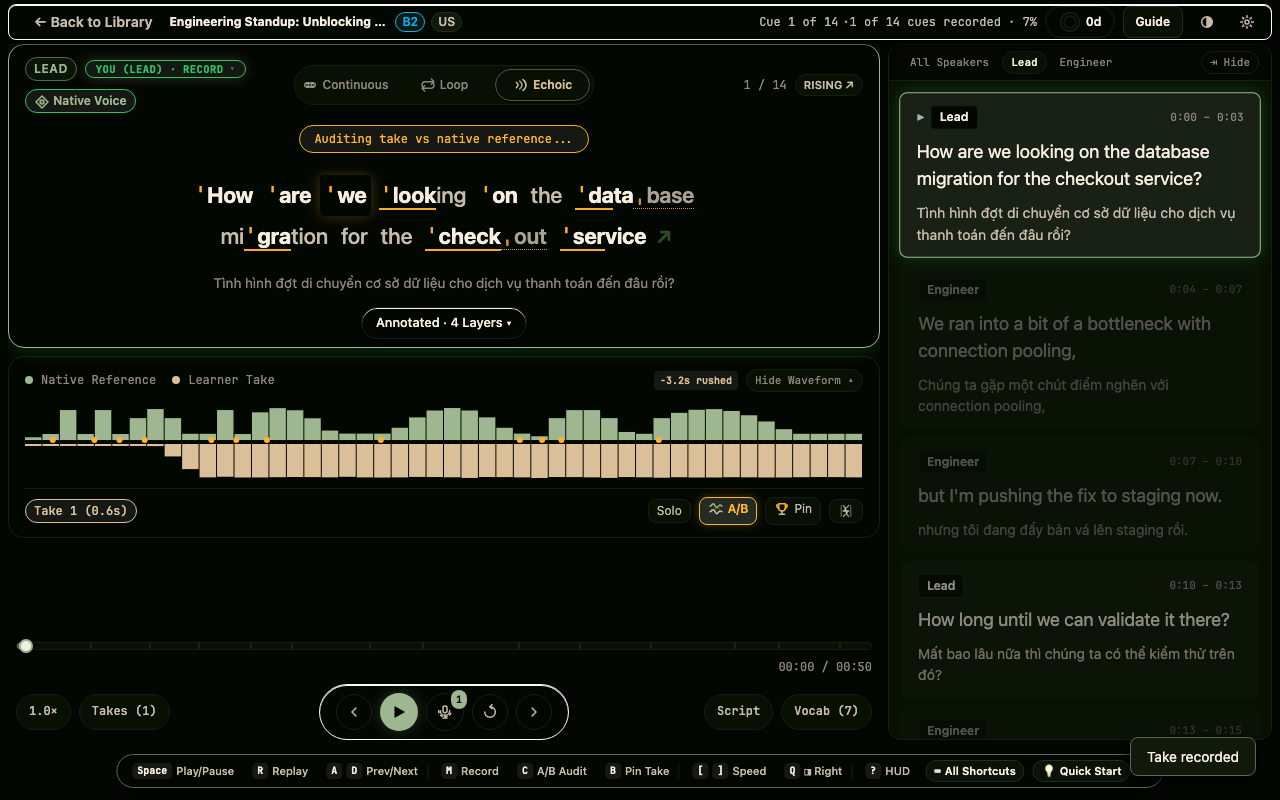
If your take is noticeably slower than the native model (>15% duration disparity), practice the cue at 0.9x speed to master linking before returning to 1.0x conversational tempo.
Focusing solely on lexical accuracy while ignoring prosodic disparity. Producing every word correctly with flat robot intonation fails the conversational test.